

Analytische Ultrazentrifugen
Analytische Ultrazentrifugation zur Charakterisierung von dispergierten Makromolekülen und Nanopartikeln
Die analytische Ultrazentrifugation (analytical ultracentrifugation, kurz AUC) ist ohne jeden Zweifel eine der vielseitigsten und genauesten Methoden, die eingesetzt wird um Proteine, Makromoleküle, Nanopartikel und andere heterogene Stoffgemische zu charakterisieren. Sie liefert Daten für die Bestimmung von Molekül- und Komplexmassen, Größen und Größenverteilungen sowie vieler thermodynamischer Parameter. Mit dieser Technik erhalten Sie eine große Bandbreite an Informationen, während sich diese Teilchen frei in dem Formulierungspuffer oder Lösungsmittel bewegen. Als orthogonale Methode kann die AUC zusätzliche Informationen zu komplementären Methoden wie Größenausschlusschromatographie (HPLC-SEC), Lichtstreumethoden, Massenspektrometrie oder Elektronenmikroskopie liefern, um somit die Methodenvalidierung deutlich zu optimieren.
Sie sind auf der Suche nach weiterführenden wissenschaftlichen Vorträgen und Webinaren ? HIER in unserer "Webinar Gallery" finden sie die aktuellsten Vorträge rund um die analytische Ultrazentrifugation.
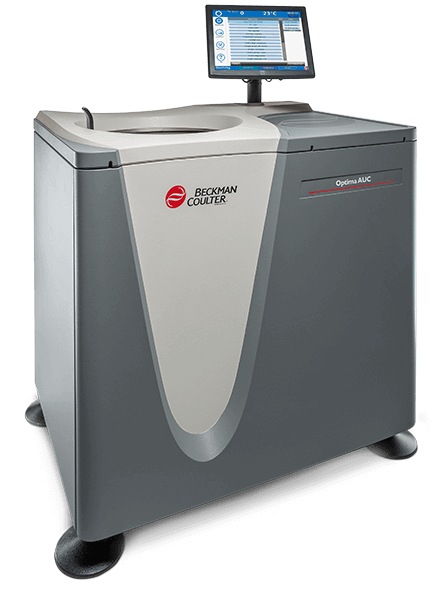
FAQ on Analytical Ultracentrifuges
What is the difference between analytical and preparative ultracentrifugation?
Preparative ultracentrifugation is primarily used to separate and isolate particles for collection, while analytical ultracentrifugation is used to characterize and measure molecular properties. Analytical systems provide quantitative information about molecular weight, sedimentation behavior, aggregation, and sample heterogeneity.
What is analytical ultracentrifugation?
Analytical ultracentrifugation (AUC) is a solution-based analytical technique that uses high centrifugal forces to study the physical properties of macromolecules and particles. Researchers use AUC to determine molecular weight, size distribution, shape, aggregation state, and molecular interactions without the need for labels or reference standards.
What are the applications of analytical ultracentrifugation?
Analytical ultracentrifugation is widely used in biopharmaceutical development, protein analysis, antibody characterization, viral vector research, nanoparticle studies, and formulation development. It is particularly valuable for studying biomolecules under conditions that closely resemble their native environment.
How does analytical ultracentrifugation work?
Analytical ultracentrifugation works by spinning samples at very high speeds and monitoring how molecules move through a solution. The rate of sedimentation is measured using optical detection systems, allowing researchers to characterize molecular size, shape, concentration, and interaction behavior with high precision.
